
JDM & Car-Culture Streetwear: A Starter Guide
JDM streetwear pulls from a specific world: late-night touge runs, boxy '90s coupes, timing boards, and the tuner scene that grew around them. It's not about slapping a car photo on a tee. The good stuff borrows the language of car culture — the silhouettes, the grids, the speed lines — and turns it into something you can wear to a meet or a bar without looking like a walking billboard. Here's how the look works and how to build it into your fits.
What "JDM streetwear" actually means
JDM stands for Japanese Domestic Market: the cars, parts, and tuning scene built in Japan for Japan. As a look it leans on hard angles, pop-up headlights, wide fender flares, and the low stance of golden-era racing coupes. Tuner culture adds the graphic vocabulary — rev counters redlining, gridded starting positions, downforce arrows, sector times.
Original artwork matters here more than in most scenes. We draw original silhouettes and motifs, so a design reads as "you get it" to another enthusiast. That's the point of car-culture streetwear tees: signal to the people who know.
The motifs that carry the look
A few visual cues do most of the work. Learn them and you can spot a lazy design from a real one.
- Silhouettes: the three-quarter rear of a boxy coupe, wheels tucked, is the single most recognisable JDM shape. Clean line art beats a busy render.
- Speed lines: horizontal motion streaks trailing a car or wrapping the sleeve. They read as movement even when you're standing still.
- Grids and timing boards: starting-grid layouts, lap counters, and sector splits borrow the cold, technical look of a pit wall.
- Kanji and technical type: vertical Japanese lettering and stencil numerals nod to the scene's origin. We use kanji as a design element, drawn cleanly, not as a fake seal.
- Redline gauges: a tach pinned past 8,000 rpm is shorthand for the whole culture.
How to wear it
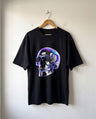
The oversized cut does a lot of the work. Our tees are 240 GSM, so the heavyweight cotton holds a boxy shape instead of clinging — the fabric drapes off the shoulder and sits flat over a graphic instead of stretching it out. That weight is why a JDM print looks sharp on the body and doesn't warp.
Keep the rest of the fit quiet. One loud graphic tee, then everything else goes neutral: baggy cargos or straight-leg denim, chunky low-tops, a cap. Layering for a Bangalore or Delhi winter? An open flannel or a zip-up over the tee frames the print without hiding it. The tee is built for the city after dark, so black, charcoal, and washed tones sit better under streetlights than anything pastel.
Two graphics fighting for attention kills the look. Pick the coupe silhouette or the timing-grid piece for a given day, not both.
Building a small rotation
You don't need ten tees. Three or four covers most of it: one silhouette piece, one speed-line or motion design, one technical grid or gauge print, and maybe one kanji-forward graphic. That spread gives you range for a car meet, a normal weekday, and a night out without repeating yourself.
If your taste runs broader than tuner culture, the golden-era-racing side sits right next door. Open-wheel numerals, pit-lane type, and podium graphics live in our open-wheel motorsport tees, and they layer cleanly with anything from the JDM side.
The made-to-order bit
Every tee is made to order and ships pan-India, with most orders arriving in 5 to 9 business days. That's slower than pulling something off a rack, and it's deliberate: nothing sits in a warehouse, and we're not overprinting designs that end up in landfill. You order, we print your size, it ships. Plan a week or two ahead of the meet you're building the fit for and you're set. Prices are in ₹, delivery is nationwide, and the artwork is ours — so the coupe on your back isn't on a thousand identical fast-fashion tees.